
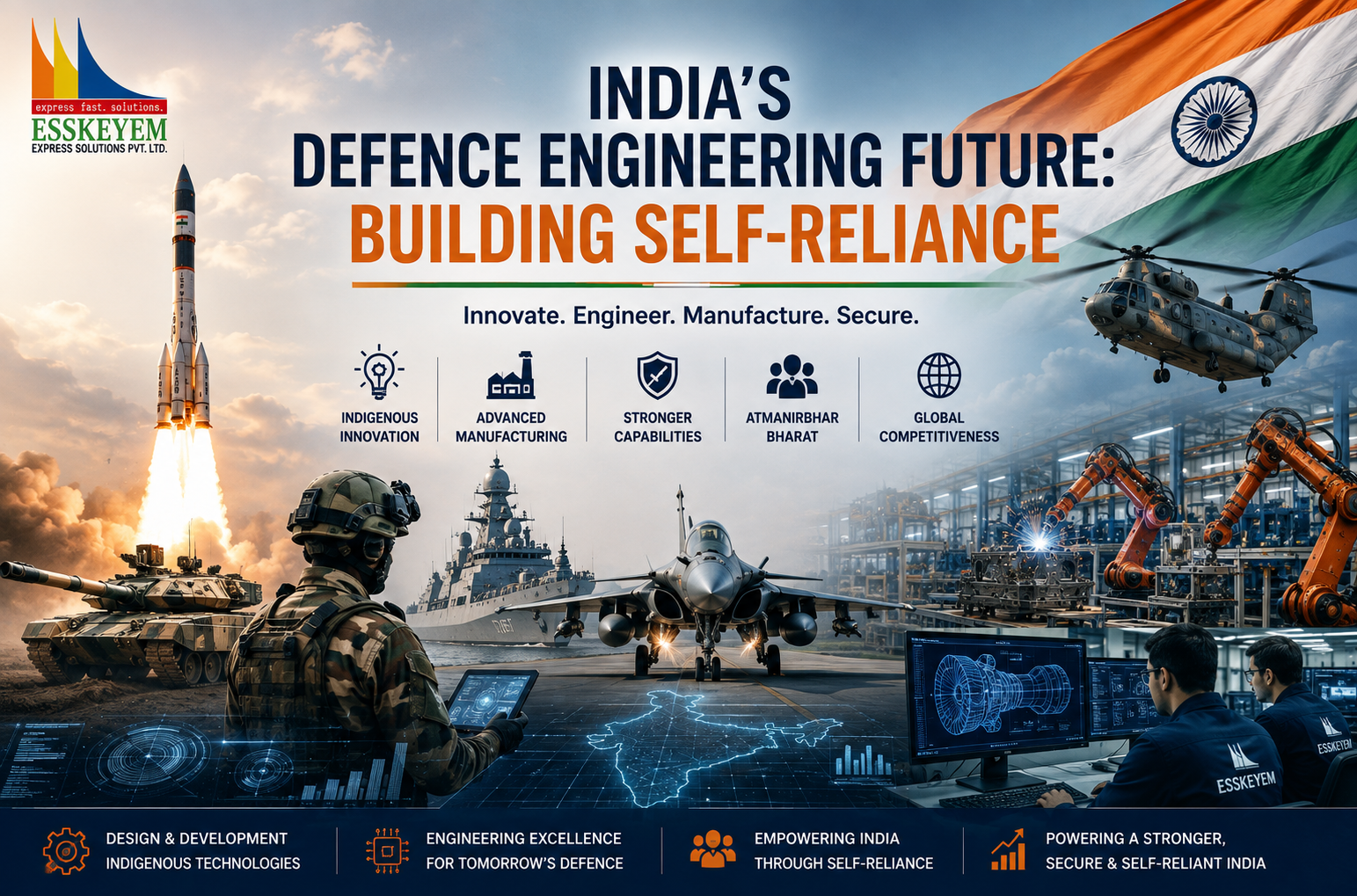
India’s Defence Engineering Future: Building Self-Reliance
India’s defence sector is undergoing a significant transformation. The country is moving beyond the traditional role of a major defence equipment buyer and steadily developing the capabilities required to design, engineer, manufacture, integrate and export advanced defence systems.
This transformation is creating new opportunities across defence engineering, aerospace, electronics, manufacturing, systems integration and technical services. For India to achieve long-term strategic self-reliance, however, manufacturing capacity alone is not enough. Strong engineering capabilities, reliable supply chains, quality systems, technology partnerships and skilled technical expertise are equally important.
India’s defence production reached a record ₹1.78 lakh crore in FY 2025–26, according to the Ministry of Defence. The figure represents a 15.6% increase over the previous financial year and more than double the FY 2020–21 level.
At the same time, defence exports reached a record ₹38,424 crore in FY 2025–26, with Indian defence products and systems being exported to more than 80 countries.
These developments indicate that India’s defence engineering ecosystem is entering a new phase—one focused not only on self-reliance, but also on global competitiveness.
From Buyer to Builder
For decades, India relied significantly on overseas suppliers for advanced defence platforms, components and technologies. Today, the strategic objective is increasingly focused on developing domestic capabilities across the entire defence value chain.
The Department of Defence Production identifies self-reliance in the design, development and production of defence equipment, weapons systems and platforms as a core objective.
This shift changes the role of engineering.
Modern defence engineering involves much more than designing a component. It encompasses system architecture, mechanical and electrical engineering, electronics, integration, testing, validation, documentation, quality assurance, configuration management and lifecycle support.
A strong engineering ecosystem allows Indian companies to develop solutions that are designed for operational requirements while also being manufacturable, maintainable and scalable.
Engineering Is the Foundation of Defence Self-Reliance
True defence self-reliance begins at the engineering stage.
When critical technologies, subsystems and components can be designed and developed domestically, India gains greater control over its defence supply chain. This can reduce dependence on external sources, improve maintainability and create opportunities for continuous product improvement.
Key areas of defence engineering include:
- Mechanical and structural engineering
- Electrical and electronic systems
- Defence electronics and communication systems
- Aerospace engineering
- Systems integration
- Design validation and testing
- Manufacturing engineering
- Technical documentation
- Quality assurance and inspection
- Lifecycle engineering support
These capabilities must work together. A technically successful design is of limited value if it cannot be manufactured consistently, tested reliably or supported throughout its operational life.
The Growing Role of Private Industry and MSMEs
India’s defence transformation is also expanding the role of private companies, startups and MSMEs.
In FY 2025–26, the private sector accounted for approximately 24% of India’s defence production, its highest share to date, according to the Ministry of Defence.
This broader industrial participation is important because modern defence programs require extensive supplier networks. Large OEMs and system integrators increasingly depend on specialized companies capable of producing components, subsystems and engineering services to demanding standards.
India’s defence ecosystem therefore needs companies that can bridge the gap between global technology providers, Indian manufacturers and end-user requirements.
This is where experienced engineering and consulting partners can create significant value—by helping organizations identify capabilities, manage technical requirements, coordinate suppliers and maintain quality throughout project execution.
Innovation and Advanced Technologies
The future of defence engineering will increasingly be shaped by advanced technologies.
Artificial intelligence, unmanned systems, advanced sensors, secure communications, electronic systems, autonomous platforms, advanced materials and precision manufacturing are changing the nature of modern defence capabilities.
India’s policy ecosystem has also increasingly emphasized innovation and domestic technology development. Initiatives such as Innovations for Defence Excellence (iDEX) have helped encourage startups and innovators to develop solutions for defence applications.
However, innovation must ultimately translate into deployable capability.
That requires engineering discipline. Technologies must be tested, validated, integrated with existing systems and manufactured consistently. Engineering organizations therefore have an important role in converting innovative concepts into reliable operational solutions.
Building Stronger Defence Supply Chains
A resilient defence industry requires more than a few large manufacturers. It needs a strong network of qualified suppliers.
India’s Defence Industrial Corridors in Uttar Pradesh and Tamil Nadu were established to strengthen the domestic defence manufacturing ecosystem, including supply chains, testing, certification and industrial capabilities.
Strong supply chains provide several advantages:
- Greater domestic availability of critical components
- Reduced dependence on vulnerable external sources
- Faster maintenance and replacement
- Better manufacturing scalability
- Development of specialized industrial capabilities
- Increased opportunities for defence exports
Supplier qualification and technical evaluation are therefore becoming increasingly important. Defence companies need partners that understand engineering requirements as well as quality, compliance and delivery expectations.
Global Partnerships and Technology Collaboration
Self-reliance does not mean isolation.
India’s growing defence industry is increasingly connected with international OEMs, technology companies and global supply chains. Strategic partnerships can provide access to advanced technologies, engineering expertise, manufacturing practices and international markets while simultaneously strengthening domestic capabilities.
The opportunity is to create partnerships where Indian engineering and manufacturing capabilities complement global technology.
For international OEMs, India offers an expanding industrial base, engineering talent and a growing domestic market. For Indian companies, collaboration with global organizations can accelerate technology development and open pathways to international supply chains.
Successful partnerships, however, require strong project management, technical coordination, compliance and quality assurance.
Quality Must Remain at the Core
Defence and aerospace systems operate in environments where reliability and performance are critical. Engineering excellence must therefore be supported by robust quality management.
Quality assurance should extend throughout the project lifecycle—from supplier selection and design review to manufacturing, inspection, testing and final delivery.
Traceability, documentation, inspection procedures, non-conformance management and compliance with applicable standards are essential components of a mature defence engineering ecosystem.
As India expands its defence exports, maintaining internationally competitive quality standards will become even more important.
How ESSKEYEM Supports India’s Defence Engineering Ecosystem
The next phase of India’s defence growth will require organizations that can connect engineering expertise with project execution, quality and industry partnerships.
ESSKEYEM provides capabilities across engineering support, project management, quality assurance and defence consulting, supporting organizations operating across the defence and aerospace ecosystem.
By combining technical understanding with project coordination and quality-focused execution, ESSKEYEM can help clients navigate complex engineering and industrial requirements while building stronger connections within India's growing defence manufacturing landscape.
The Road Ahead
India’s defence engineering journey is moving from capability creation toward capability maturity.
Record production, rising exports, greater private-sector participation and expanding domestic supply chains demonstrate the scale of this transformation.
The next challenge is to deepen engineering capabilities, develop reliable suppliers, accelerate innovation and consistently meet global standards.
For India, defence self-reliance is ultimately about more than producing equipment domestically. It is about developing the knowledge, engineering capability, technology, infrastructure and industrial ecosystem required to design and sustain critical defence systems.
As India strengthens its position as a global defence manufacturing hub, engineering will remain one of the foundations of that journey.
ESSKEYEM is positioned to support this transformation through defence engineering, project management, quality assurance and strategic industry support—helping organizations turn complex defence requirements into reliable, executable solutions.