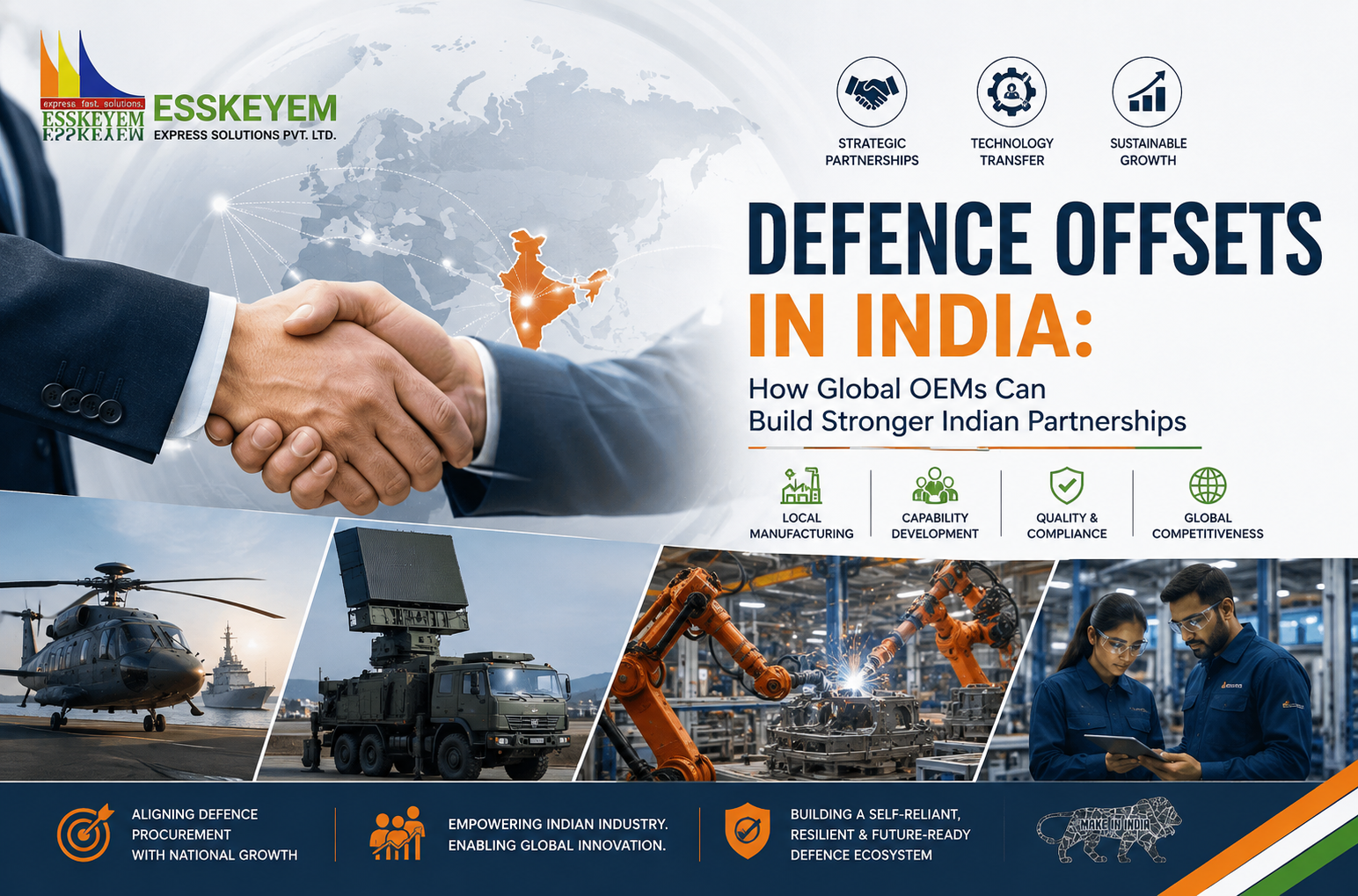
Defence Offsets in India: How Global OEMs Can Build Stronger Indian Partnerships
India is rapidly emerging as an important destination for defence manufacturing, engineering, technology partnerships and global supply-chain integration. With the country's defence production reaching a record ₹1.78 lakh crore in FY 2025–26 and defence exports reaching ₹38,424 crore, the Indian defence ecosystem is expanding beyond traditional government-led procurement.
For international Original Equipment Manufacturers (OEMs), this transformation presents significant opportunities. India offers a growing network of manufacturers, engineering companies, MSMEs, technology providers and skilled professionals that can support localisation and long-term industrial partnerships.
One important mechanism within India's defence acquisition framework is the defence offset system. When properly planned and executed, offsets can go beyond fulfilling contractual requirements. They can help global OEMs establish reliable Indian partnerships, develop local manufacturing capabilities, strengthen supply chains and create sustainable business opportunities.
What Are Defence Offsets?
Defence offsets are industrial or economic obligations associated with certain eligible defence procurement contracts. Their purpose is to leverage defence acquisitions to strengthen India's domestic defence industrial capabilities.
The Defence Offset Management Wing (DOMW), under the Department of Defence Production, is responsible for formulating offset guidelines and managing post-contract implementation, including monitoring offset obligations, reviewing progress reports and processing offset claims.
Under the Defence Acquisition Procedure framework, offset provisions apply to specified procurement categories and thresholds, with the applicable requirements determined by the relevant acquisition case and contract. Therefore, global OEMs should evaluate the specific RFP, contract conditions and prevailing regulations rather than assuming that every defence procurement carries the same offset obligation.
Why India Is Becoming More Attractive to Global OEMs
India's defence industrial base has expanded considerably in recent years. The private sector accounted for approximately 24% of defence production in FY 2025–26, its highest share to date. Defence exports also reached more than 80 countries, demonstrating the increasing integration of Indian companies into international defence supply chains.
For global OEMs, this growth creates opportunities to identify Indian suppliers capable of supporting:
- Component and subsystem manufacturing
- Engineering and design support
- Electronics and communication systems
- Assembly and integration
- Testing and validation
- Maintenance and lifecycle support
- Research and development
- Export-oriented manufacturing
India's expanding industrial ecosystem means an OEM can potentially develop partnerships that deliver value well beyond the initial procurement program.
Offsets Should Be Viewed as a Strategic Opportunity
A common mistake is to treat an offset obligation simply as a compliance exercise.
A stronger approach is to view offsets as a strategic industrial-development opportunity.
The right Indian partnership can help an OEM develop a qualified local supply base, reduce production lead times, establish engineering support capabilities and create a foundation for future contracts.
For example, an OEM may identify an Indian manufacturing company capable of producing selected components to international specifications. With appropriate technical support, quality systems, documentation and process development, that relationship can evolve into a long-term supplier partnership.
This creates value for both sides: the OEM develops local capability while the Indian company gains technical expertise, manufacturing experience and access to a global supply chain.
Selecting the Right Indian Offset Partner
Partner selection is one of the most important decisions in an offset program.
According to government information, the OEM/vendor/Tier-I sub-vendor is free to select an Indian Offset Partner (IOP), subject to the applicable rules and eligibility requirements. The government does not select the IOP on behalf of the OEM.
This makes due diligence essential.
An effective partner evaluation should consider:
Technical capability: Does the company have the engineering knowledge and manufacturing capabilities required for the program?
Quality systems: Can the organization consistently meet applicable defence and aerospace quality requirements?
Infrastructure: Does it have appropriate machinery, testing facilities, production capacity and technical resources?
Financial strength: Can the company support the expected investment and sustain production over the required period?
Scalability: Can the supplier increase capacity as program requirements grow?
Compliance: Does the organization maintain appropriate legal, regulatory and contractual compliance?
Experience: Has the company worked with defence, aerospace or other highly regulated industries?
The objective should not simply be to find an available supplier. It should be to identify a partner capable of becoming a dependable part of the OEM's Indian industrial ecosystem.
Technology Transfer and Capability Development
Technology transfer can be an important element of defence industrial cooperation. Under the applicable framework, technology-related activities may qualify as eligible offset avenues subject to prescribed conditions.
For OEMs, technology cooperation can help establish local manufacturing capabilities while improving the technical maturity of Indian partners.
Successful technology transfer requires more than handing over technical documents. It can involve training, process knowledge, engineering support, production methodologies, quality systems, tooling and technical assistance.
A structured technology-transfer program should therefore define responsibilities, documentation requirements, training, acceptance criteria and measurable capability-development milestones.
Strengthening the Indian Defence Supply Chain
India's defence transformation increasingly depends on deeper and more resilient domestic supply chains.
The government's current focus on indigenisation has expanded opportunities for domestic manufacturers, MSMEs, startups and specialist engineering companies. Government initiatives have also supported the identification and development of products that can be manufactured domestically.
For global OEMs, this creates an opportunity to build multi-tier supplier networks rather than relying on a single local partner.
A robust Indian supply chain can provide:
- Greater sourcing flexibility
- Faster access to components
- Local engineering support
- Improved maintenance capabilities
- Reduced supply-chain risks
- Opportunities for future exports
- Greater integration with India's defence ecosystem
Building these capabilities early can provide an OEM with an advantage when pursuing future Indian programs.
The Importance of Quality and Compliance
Defence manufacturing requires exceptional attention to quality, traceability, inspection and documentation.
An Indian supplier may have strong manufacturing capabilities but still require improvements in quality processes, documentation, testing or configuration management before becoming part of an international OEM's supply chain.
Quality assurance should therefore begin during supplier evaluation rather than after production starts.
OEMs should assess manufacturing processes, inspection capabilities, documentation practices, testing procedures, corrective-action systems and overall quality maturity.
This approach reduces project risk and helps create a more dependable industrial partnership.
Project Management Makes Offsets Successful
Offset programs can involve multiple stakeholders, technical requirements, commercial commitments, regulatory obligations and reporting milestones.
Effective project management is therefore essential.
A structured approach should include:
- Defining offset objectives and deliverables
- Identifying and evaluating Indian partners
- Establishing technical and commercial responsibilities
- Developing implementation schedules
- Monitoring supplier development
- Tracking documentation and claims
- Managing quality and compliance
- Reporting progress against contractual requirements
The DOMW portal supports OEM onboarding, management of Indian Offset Partners and Tier-I vendors, offset discharge schedules, progress reporting, claims and audit-related processes.
Professional project coordination can help ensure that industrial objectives remain aligned with contractual obligations.
How ESSKEYEM Can Support Global OEMs
For international defence companies entering or expanding within India, local knowledge can make a significant difference.
ESSKEYEM provides capabilities across offset solutions, project management, engineering support and quality assurance, helping organizations navigate complex defence and aerospace requirements.
Its role can include identifying suitable Indian industrial capabilities, supporting supplier relationships, coordinating technical requirements, assisting project execution and maintaining focus on quality and compliance.
By connecting international organizations with India's developing defence and engineering ecosystem, ESSKEYEM can support global OEMs seeking practical, reliable and long-term Indian partnerships.
Building Partnerships Beyond Compliance
India's defence sector is moving rapidly toward greater domestic production, technology development and international integration. With defence production and exports reaching record levels, the opportunity for global OEMs is becoming increasingly significant.
The most successful offset programs will not simply satisfy contractual requirements. They will create capability, relationships and long-term industrial value.
For global OEMs, the priority should be to identify the right Indian partners, develop sustainable technical capabilities, establish strong quality systems and integrate local suppliers into broader global supply chains.
Defence offsets can therefore become much more than an obligation. They can serve as a strategic pathway for building a stronger presence in India.
With the right combination of local expertise, engineering capability, project management and quality assurance, global OEMs can turn India's growing defence ecosystem into a platform for long-term partnership, manufacturing and innovation.