
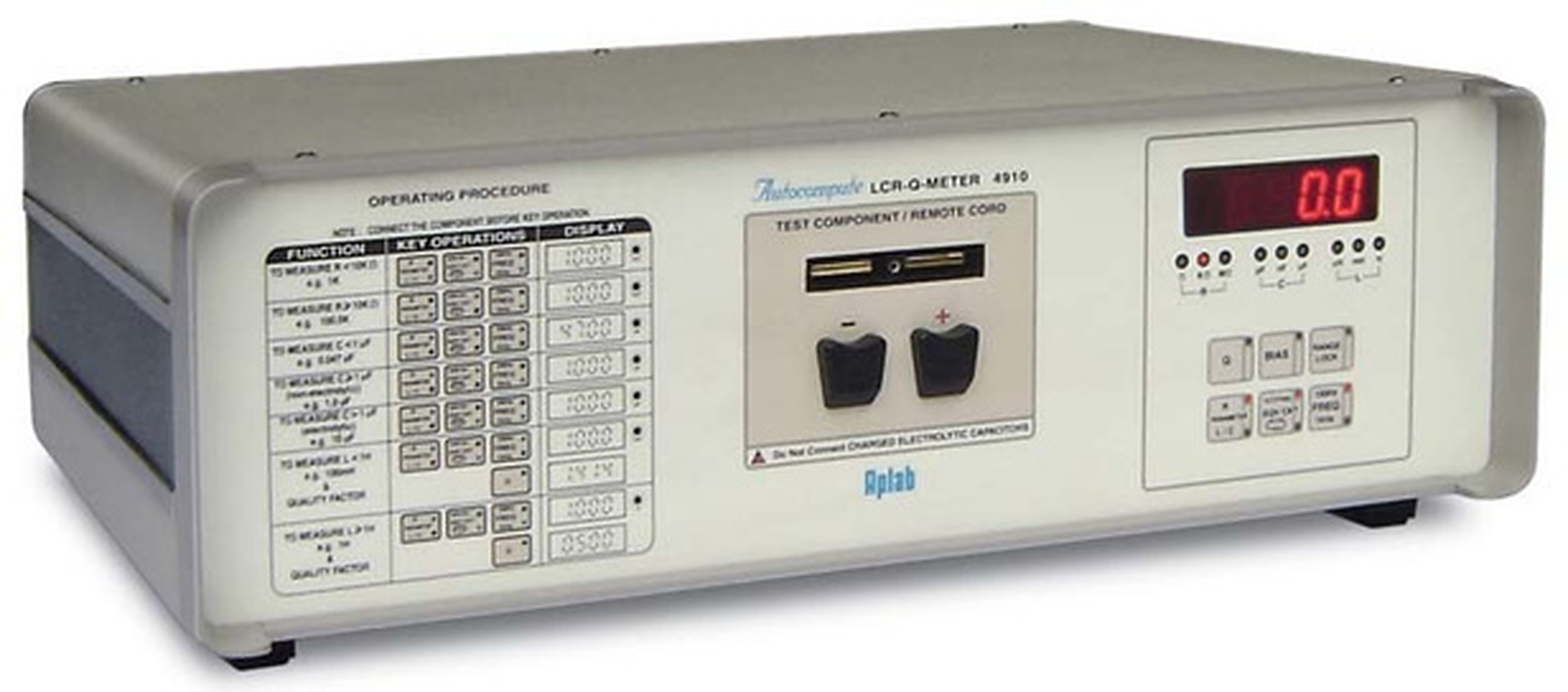
Product Description
The APLAB Model 4910 Autocompute LCR-Q Meter Is A Microprocessor-based Digital Measurement Instrument Developed For Laboratory Testing, Production-line Inspection, And Quality Assurance Applications. It Provides Fully Automatic Operation With Autoranging Measurement Of Inductance, Capacitance, Resistance, And Quality Factor.
The Instrument Combines Automatic Range Selection With Direct Digital Readout, Allowing Users To Perform Component Measurements With Minimal Manual Adjustment. It Can Measure L, C, R And Q Parameters While Automatically Discriminating Between Inductors And Capacitors.
Flexible Series And Parallel Measurement
The Model 4910 Allows Component Values To Be Displayed Using Either series Equivalent Or Parallel Equivalent Measurement Modes. Users Can Select A Measurement Frequency Of 100Hz Or 1kHz, Depending On The Component And Application Requirements.
This Flexibility Makes The Meter Suitable For Different Component-testing Requirements While Its Automatic Operating System Assists Users In Selecting An Appropriate Measurement Mode And Frequency. When An Unsuitable Selection Is Made, The Corresponding Measurement-unit LED Flashes To Prompt Corrective Action.
Precision Four-Terminal Measurement
A Key Feature Of The Model 4910 Is Its four-terminal Measurement Technique. This Arrangement Helps Reduce Errors Associated With Electromagnetic Coupling In Measurement Leads While Also Reducing The Effects Of Residual Inductance And Stray Capacitance.
The Instrument Provides A Dedicated Integral Test Jig That Accommodates Common Component-lead Diameters. Both Radial And Axial Components Can Be Inserted Directly Into The Test Jaws, Making Routine Component Testing Convenient. Release Buttons Assist With Inserting Components Having Particularly Flexible Leads.
Measurement Accuracy And Range
The Model 4910 Provides A Basic Measurement Accuracy Of ±0.25% Of Reading For Specified Measurement Ranges. According To The Supplied Documentation, This Basic Accuracy Applies To Values Up To 2000H For Inductance, 2000μF For Capacitance, 2MΩ For Resistance, And Q Factor Up To 99.
For Measurements Beyond The Basic Accuracy Range, The Instrument Can Measure Inductance Up To 9999H, Capacitance Up To 9999μF, And Resistance Up To 100MΩ At Degraded Accuracy.
Built-In DC Bias For Capacitor Testing
An Internal 2V DC Bias Voltage Can Be Selected When Testing Electrolytic Capacitors. This Feature Provides An Additional Testing Condition For Applications Where Capacitor Measurements Need To Be Performed With An Applied DC Bias.
Convenient Component Connection
The Integral Test Fixture Is Designed To Make Component Insertion And Removal Straightforward. Radial And Axial Components Can Be Connected Directly Through The Test Jaws, While The Supplied Remote Probe Helps Simplify Testing Of Both Small And Larger Components.
The Meter Is Designed As An Economical And Portable Instrument While Retaining Functions Required For Laboratory, Production, And Quality-assurance Environments. Its Self-test Facility Further Supports Routine Instrument Operation.
Key Features
- Microprocessor-based Automatic L, C, R And Q Measurement.
- Fully Automatic Autoranging Operation.
- Direct Digital Measurement Readout.
- Four-terminal Measurement Technique.
- Series And Parallel Equivalent Measurement.
- Selectable 100Hz And 1kHz Test Frequencies.
- Automatic Inductor And Capacitor Discrimination.
- Internal 2V DC Bias For Electrolytic Capacitor Testing.
- Integral Component Test Jig.
- Remote Probe For Convenient Component Testing.
- Self-test Facility.
- Compact And Economical Design.
Product Specifications
APLAB 4910
Autocompute LCR-Q Meter
L, C, R & Q
Series or parallel equivalent
User selectable 100Hz or 1kHz
±0.25%
0.1μH to 9999H
0.1pF to 9999μF
0.001Ω to 100MΩ
0.1 to 99
0.1μH
0.1pF
0.001Ω
0.01
0.285V RMS
0.8V p-p approx.
2 per second
1 second maximum
4-digit, 7-segment LED
12.5mm
4-terminal integral test jig
2V
Up to 2000H
Up to 2000μF
Up to 2MΩ
Up to 99
Up to 9999H
Up to 9999μF
Up to 100MΩ
0.25 to 4
Up to 10mF capacitor at ≤50V
250mA
0°C to 40°C
230V AC ±10%, 47–53Hz
115V AC ±10%, 57–63Hz
430 × 150 × 335mm approx.
4kg approx.
Instruction manual, remote probe, mains cord